Microsoft Fabric Meets Copilot: AI That Supercharges Your Data Workflows

Microsoft Fabric with Copilot turns complex data tasks into simple conversations, letting teams build, analyze, and act faster across lakehouses, pipelines, and reports. This combo unifies your data estate while AI handles the heavy lifting for insights and automation.​

Copilot Across Fabric Workloads

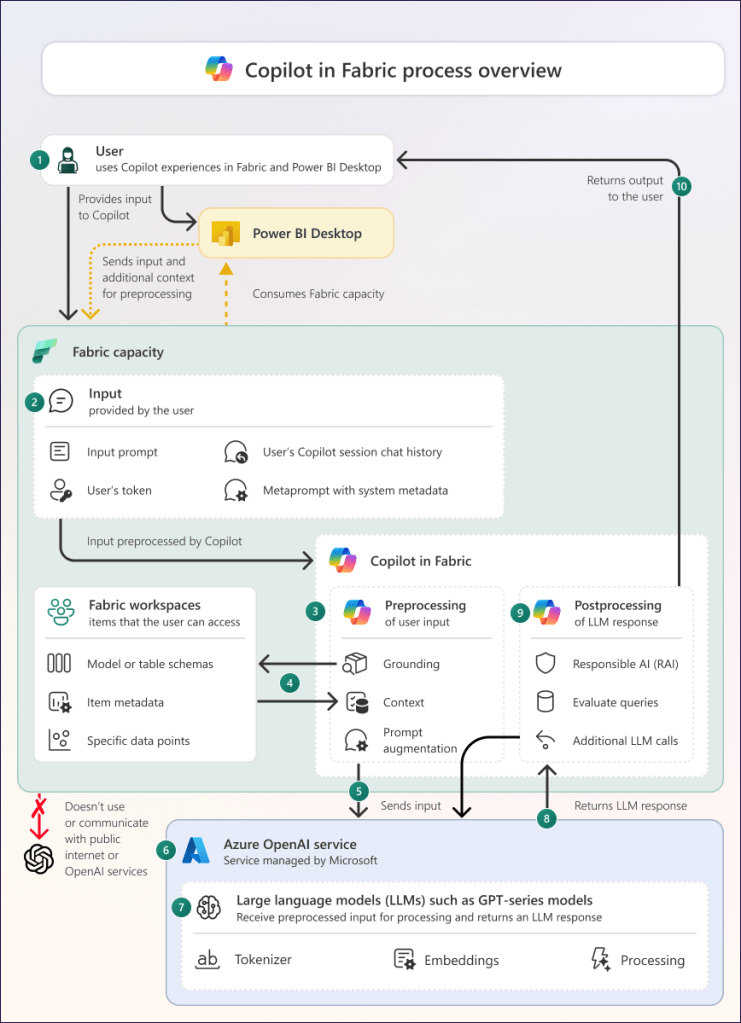
Copilot works seamlessly in notebooks, Data Factory, Power BI, and Real-Time Intelligence. In notebooks, it generates Python or Spark code from natural language like “Add revenue columns and plot trends.” Data Factory users prompt “Build a pipeline to clean sales data and join with inventory,” and Copilot creates the steps with error fixes.​

Power BI Copilot drafts reports: “Summarize churn by region with visuals,” pulling from OneLake for instant dashboards. Real-Time Intelligence converts prompts to KQL queries for live streams, like spotting shipment delays.​​

Real-World Samples in Action

Sales teams ask: “Show customer churn trends by region.” Copilot queries Fabric warehouses, generates a map and KPIs, ready for Dynamics 365 embedding.​

Finance prompt: “Highlight monthly cash flow anomalies.” It scans unified ledgers, flags outliers, and suggests forecasts via Power BI visuals.​

Manufacturing: “Flag machines with downtime risks.” Copilot builds real-time dashboards from IoT streams, alerting on patterns with auto-generated alerts.​

Quick Setup and Best Practices

Enable Copilot in the Fabric admin portal for F64+ capacities—it’s on by default for paid SKUs. Start with security groups for pilot users, then train on prompts like “Explain this dataset” or “Optimize this query.”​

Pro tip: Load data as dataframes for best results; Copilot understands schema and suggests transformations. Track ROI by time saved on ETL and analysis.​

Why It Changes Everything for Data Leaders

Fabric + Copilot cuts dev time 50% while scaling enterprise analytics. Integrate with Purview for governance, then deploy agents for ongoing insights—your path to AI-driven decisions without the hassle.​

#MicrosoftFabric #Copilot #DataAI

Azure AI Foundry: From AI Experiments to Enterprise AI Execution

Artificial Intelligence has entered a new phase. The conversation is no longer only about building impressive demos or isolated copilots. Enterprises now want AI solutions that are secure, governed, measurable, scalable, and connected to real business processes.

This is where Azure Foundry, now part of Microsoft Foundry, becomes a strategic platform for organizations looking to move from AI experimentation to AI execution. Microsoft describes Foundry as a unified Azure platform-as-a-service offering for enterprise AI operations, model builders, and application development, bringing agents, models, tools, monitoring, evaluations, role-based access control, networking, and policies into one enterprise-ready foundation.

The Shift From AI Innovation to AI Industrialization

Many organizations have already tested generative AI. They have built chatbots, document summarizers, internal assistants, and proof-of-concept applications. These projects create excitement, but they often expose a bigger problem.

The challenge is not whether AI works. The challenge is whether AI can be trusted, governed, integrated, and scaled across the enterprise.

Common questions quickly appear:

How do we control which models teams can use?How do we protect sensitive enterprise data?How do we monitor AI quality and cost?How do we evaluate agent responses?How do we avoid disconnected AI pilots?How do we deploy AI into production safely?How do we align AI with governance and business outcomes?

Azure Foundry helps address these challenges by creating a structured foundation for building, deploying, evaluating, and managing AI applications and agents.

What Makes Azure Foundry Different?

Azure Foundry is not just another AI playground. It is designed to support the full AI application lifecycle. It brings together the key building blocks organizations need to create production-ready AI systems.

At a high level, Azure Foundry helps teams:

Discover and deploy modelsBuild AI applicationsCreate intelligent agentsConnect to enterprise dataEvaluate quality and safetyMonitor usage and performanceApply governance and access controlsScale AI across teams and business units

Microsoft’s Foundry architecture is organized around a layered model: a top-level Foundry resource for governance, projects for development isolation, and connected Azure services for capabilities such as storage, search, and secrets management.

This matters because enterprise AI requires more than model access. It requires architecture, operating discipline, security, observability, and continuous improvement.

Enterprise Architecture View

A practical Azure Foundry architecture can be understood in six layers:

1. User Experience Layer Web apps, mobile apps, Teams, Copilot experiences, portals, APIs2. AI Application Layer Chat interfaces, copilots, AI workflows, business agents3. Azure Foundry Layer Projects, agents, models, prompts, tools, evaluations4. Knowledge and Data Layer Azure AI Search, Microsoft Fabric, Databricks, SQL, Data Lake, APIs5. Security and Governance Layer Microsoft Entra ID, RBAC, Key Vault, private networking, Azure Policy6. Operations Layer Monitoring, tracing, cost management, feedback, continuous evaluation

This layered approach allows organizations to avoid fragmented AI adoption. Instead of building one-off solutions, they can create reusable patterns for knowledge assistants, workflow agents, document intelligence, predictive insights, and enterprise copilots.

The Role of Agents in Modern AI

The future of enterprise AI is not just chat. It is agentic execution.

A chatbot answers questions. An agent can reason, retrieve data, use tools, call APIs, complete tasks, and support business workflows. Microsoft Foundry Agent Service is described as a fully managed platform for building, deploying, and scaling AI agents. It supports no-code prompt agents in the Foundry portal, SDK and REST API development, and code-based hosted agents built with frameworks such as Agent Framework and LangGraph.

A simple enterprise agent pattern looks like this:

User Request |Agent Instructions |Model Reasoning |Enterprise Data Retrieval |Tool or API Execution |Response, Action, Audit, and Feedback

For example, a field operations agent could review a work order, search historical maintenance records, check inventory availability, summarize risk, recommend next steps, and trigger a workflow.

That is where AI moves from productivity support to operational transformation.

Why Data Grounding Is Critical

One of the biggest risks with generative AI is ungrounded output. A model can generate a confident answer that may not reflect the organization’s actual policies, data, or context.

That is why Retrieval-Augmented Generation, or RAG, is a core enterprise AI architecture pattern. Instead of asking the model to rely only on its general knowledge, RAG connects AI applications to trusted enterprise sources.

A typical RAG architecture with Azure Foundry may look like this:

Enterprise SourcesSharePoint, PDFs, SQL, Fabric, Databricks, CRM, ERP, APIs |Data ProcessingChunking, metadata enrichment, cleansing, access filtering |Indexing LayerAzure AI Search or vector index |Azure Foundry Agent or AI Application |Grounded Response with Business Context |Monitoring and Feedback Loop

Microsoft’s baseline Foundry chat reference architecture describes an enterprise chat application where an agent receives user messages and queries data stores to retrieve grounding information for the language model.

This is the difference between a generic AI assistant and a trusted enterprise AI solution.

Governance: The Foundation of Trust

AI without governance creates risk. AI with governance creates confidence.

Azure Foundry supports enterprise readiness through capabilities such as role-based access control, networking, policies, tracing, monitoring, and evaluations under a unified Azure management model.

For architects and technology leaders, governance should answer five key questions:

Who is allowed to build AI solutions?Which models are approved for use?What enterprise data can be connected?How are outputs evaluated and monitored?How do we manage risk, cost, and compliance?

Microsoft also provides responsible AI guidance for Foundry, including security, observability, governance, and checkpoints across the agent lifecycle.

This is especially important for regulated industries such as financial services, healthcare, energy, government, and insurance, where AI decisions and outputs must be explainable, controlled, and auditable.

Evaluation: Turning AI From Demo to Production

A demo only needs to work once. A production AI system needs to work consistently.

Evaluation is one of the most important parts of enterprise AI architecture. Organizations must measure whether their AI applications are accurate, grounded, safe, reliable, cost-effective, and useful.

For agentic AI, evaluation becomes even more important because the system may use tools, call APIs, follow workflows, and make multi-step decisions. Microsoft Foundry includes agent evaluators such as task completion, task adherence, intent resolution, tool call accuracy, and tool selection.

A strong evaluation framework should include:

Response qualityGroundednessRelevanceSafetyIntent resolutionTask completionTool call accuracyLatencyCost per interactionUser feedbackBusiness outcome impact

This is how organizations move from “the AI sounds good” to “the AI is measurable, reliable, and ready for production.”

Monitoring and Observability

Once AI is deployed, leaders need visibility. They need to understand how agents are performing, how much they cost, how users are interacting with them, and where quality issues are occurring.

Microsoft documents an Agent Monitoring Dashboard in Foundry that can track operational metrics, token usage, latency, success rates, and evaluation outcomes for production traffic.

This operational layer is essential because AI systems are dynamic. Prompts change. Data changes. User behavior changes. Models evolve. Business processes shift.

Without monitoring, AI becomes a black box. With monitoring, AI becomes an operational capability.

Recommended Enterprise Rollout Approach

To successfully adopt Azure Foundry, organizations should avoid jumping directly into large-scale deployment. A phased approach works best.

Phase 1: Identify High-Value Use Cases

Start with business problems where AI can create measurable value. Good candidates include knowledge search, document processing, customer service, operational support, compliance review, and executive insights.

Phase 2: Establish the Architecture Foundation

Define the enterprise architecture pattern for models, agents, data access, networking, identity, monitoring, and governance.

Phase 3: Build a Controlled Pilot

Select one or two high-value use cases. Build them with proper security, grounding, evaluation, and feedback loops.

Phase 4: Create Reusable Patterns

Turn successful pilots into reusable templates. This may include RAG patterns, agent templates, evaluation frameworks, monitoring dashboards, and deployment standards.

Phase 5: Scale Across the Enterprise

Expand adoption across departments while maintaining governance, cost control, and architectural consistency.

Microsoft’s planning guidance for Foundry highlights the importance of structured rollout decisions around environment setup, data isolation, governance, integration with Azure services, capacity management, and monitoring.

Business Impact of Azure Foundry

The real value of Azure Foundry is not only technical. It is business transformation.

With the right architecture, organizations can use Azure Foundry to:

Reduce manual workImprove decision-makingAccelerate knowledge discoveryAutomate repetitive workflowsEnhance customer experienceImprove operational visibilityStrengthen governance and complianceCreate reusable AI delivery patterns

The goal is not to build one chatbot. The goal is to create an AI operating model that allows the business to innovate safely, quickly, and repeatedly.

Final Thought

Azure Foundry represents a major shift in enterprise AI. It helps organizations move beyond scattered experimentation and toward governed, scalable, production-ready AI execution.

The organizations that will win with AI are not necessarily the ones with the most pilots. They will be the ones that build the strongest foundation: secure data access, trusted models, governed agents, measurable quality, operational monitoring, and clear business alignment.

AI success is not about chasing hype. It is about building trust, scale, and business value.

With Azure Foundry, enterprises have a powerful platform to turn AI ambition into real-world execution.

Building the Windsor Microsoft Technical Fraternity: A Community Journey in Azure, AI, and Innovation

Community has always been at the heart of technology. While tools, platforms, and frameworks continue to evolve, the real power of technology comes from people who are willing to learn, share, collaborate, and grow together.

With great pride and gratitude, I am excited to share my journey as the User Group Owner of the Windsor Microsoft Technical Fraternity in Windsor, Ontario. This community initiative is focused on bringing together technology professionals, students, developers, architects, data leaders, cloud practitioners, and Microsoft enthusiasts to learn and exchange ideas around Microsoft technologies.

Creating a Platform for Learning and Collaboration

The vision behind the Windsor Microsoft Technical Fraternity is simple: create a strong local and virtual community where people can explore Microsoft Azure, AI, Data, Microsoft Fabric, Power Platform, cloud modernization, cybersecurity, and enterprise architecture in a practical and accessible way.

Windsor is a growing technology region with strong connections to manufacturing, automotive, healthcare, education, entrepreneurship, and cross-border business. As technology continues to transform every industry, it is important to create local platforms where professionals can stay current, build confidence, and learn from real-world experience.

Through this user group, we are creating a space where knowledge is shared openly and where every participant, whether beginner or expert, feels welcome to contribute.

In-Person and Virtual Community Events

One of the most exciting parts of leading this group is the ability to host both in-person and virtual technical events.

Our in-person events provide the opportunity for local professionals in Windsor and surrounding areas to connect face-to-face, build relationships, ask questions, and learn directly from speakers and peers. These sessions help strengthen the local technology ecosystem and create meaningful professional connections.

Our virtual events allow us to extend the reach beyond Windsor, connecting with speakers, MVPs, architects, and technology leaders from across Canada and around the world. This hybrid model gives the community the best of both worlds: local engagement and global knowledge sharing.

Focus Areas of the Community

The Windsor Microsoft Technical Fraternity is focused on practical, high-impact technology topics, including:

  • Microsoft Azure and cloud architecture
  • Azure AI and generative AI
  • Azure AI Foundry and intelligent applications
  • Microsoft Fabric and modern data platforms
  • Power BI and analytics
  • Data governance and enterprise architecture
  • DevOps, automation, and application modernization
  • Responsible AI and secure cloud adoption

The goal is not only to talk about technology, but to show how it can be applied in real business and community scenarios.

Why This Community Matters

Technology is moving faster than ever. AI, cloud, data, and automation are changing how organizations operate and how professionals build their careers. In this environment, continuous learning is no longer optional. It is essential.

User groups play a powerful role in this journey. They help people stay informed, ask questions, share experiences, discover opportunities, and grow their confidence. They also create a bridge between global innovation and local impact.

For me, leading the Windsor Microsoft Technical Fraternity is not just about organizing events. It is about building a learning ecosystem where people can grow together.

A Mission Rooted in Contribution

As a Microsoft MVP and community leader, I strongly believe that technical knowledge becomes more powerful when it is shared. Every event, session, discussion, and connection is an opportunity to help someone learn something new, solve a problem, or take the next step in their career.

The Windsor Microsoft Technical Fraternity is built on that belief.

Our mission is to:

  • Educate the community on modern Microsoft technologies
  • Empower professionals and students with practical knowledge
  • Connect local talent with global technology leaders
  • Create a safe and welcoming space for learning
  • Promote innovation across Windsor and beyond

Looking Ahead

As we continue to grow, I am excited to bring more speakers, more technical sessions, more hands-on learning, and more opportunities for collaboration to the Windsor technology community.

Whether you are a student exploring cloud for the first time, a developer building modern applications, a data professional working with analytics, or a business leader trying to understand AI transformation, this community is for you.

The future of technology will be shaped by communities that learn together, build together, and support each other. I am honored to contribute to that mission through the Windsor Microsoft Technical Fraternity.

Thank you to everyone who has supported this journey. Your participation, encouragement, and passion for learning continue to inspire this community forward.

Let’s continue to learn, connect, and grow together.

Azure AI Foundry: The Enterprise AI Control Plane You’ve Been Waiting For

What Azure AI Foundry Is

Azure AI Foundry (now branded simply as Microsoft Foundry) is a unified environment to design, build, evaluate, and operate AI applications and agents at scale. It brings together model catalog, orchestration, security, governance, and MLOps in a single, enterprise-ready experience.​

  • It provides access to a broad catalog of foundation models, including OpenAI GPT, Anthropic Claude, and other third-party or open-source models under one roof.​
  • Teams can collaborate in projects that bundle datasets, prompts, tools, agents, and deployment assets with built-in lifecycle management.​

Key Capabilities That Matter

Under the hood, Azure AI Foundry is much more than a model playground; it is an opinionated platform for building production workloads.​

  • Unified development experience: SDKs, CLI, and a portal provide consistent workflows with versioning, reusable components, and integrated notebooks for end-to-end AI development.​
  • Agentic experiences: Foundry Agent Service enables multi-agent orchestration, tool usage via Model Context Protocol, and deep integration into Microsoft 365 and business systems.​
  • Native MLOps: Built-in pipelines support training, evaluation, deployment, and monitoring of models with CI/CD via GitHub and Azure DevOps.​

Governance, Security, and Responsible AI

For enterprises, AI is only real when it is secure, governed, and compliant. Azure AI Foundry leans heavily into these requirements.​

  • Enterprise governance: Role-based access control, audit trails, and project-level isolation help segment workloads and protect sensitive assets.​
  • Data control: Organizations can bring their own storage and Key Vault, ensuring data residency, encryption, and retention align with internal policies.​
  • Risk and safety tooling: Content filtering, policy configurations, and evaluation workflows support responsible AI practices across models and scenarios.​

Architecting Real-World Use Cases

The real power of Foundry shows up when it is applied to concrete business problems.​

  • RAG and knowledge agents: Foundry makes it straightforward to build Retrieval-Augmented Generation experiences over secured enterprise data, reducing the need for heavy fine-tuning.​
  • Line-of-business copilots: With connectors into Microsoft 365, Dynamics, and hundreds of SaaS systems, you can design agents that work across email, documents, CRM, and operations data.​
  • Edge and hybrid scenarios: Support for cloud, on-premises, and edge deployment enables predictive maintenance, IoT analytics, and offline/low-connectivity use cases.​

Strategic Guidance for Data & AI Leaders

For architects and data leaders, Azure AI Foundry is not just another service; it is a strategic control plane for enterprise AI.​

  • Treat Foundry as the standard entry point for generative AI, with central governance over models, prompts, tools, and data connections.​
  • Align AI projects with existing data platforms (Fabric, Synapse, lakehouses) and security baselines, so Foundry becomes an extension of your broader data and cloud strategy—not a silo.​
  • Start with high-impact, low-friction scenarios—knowledge copilots, developer productivity, and customer service—and then scale into multi-agent, cross-domain workflows as maturity increases.​

Microsoft MVP PGI Invitation – Interaction and Feedback on AI Platform Deep Dive on Private Chatbots, Assistants and Agents

Over the past years, I had the incredible opportunity to attend several Microsoft Product Group Interactions (PGIs)—exclusive sessions where Microsoft MVPs engage directly with the product teams shaping the future of the Microsoft cloud ecosystem.

These PGIs focused on some of the most exciting innovations in the Azure AI space, including:

✅ Azure Patterns & Practices for Private Chatbots and Assistants
✅ Azure AI Agents & Tooling Frameworks
✅ Secure, Enterprise-Grade Architectures for Private LLMs

As a Microsoft MVP in Azure & AI, it’s always energizing to engage directly with the engineering teams and share insights from real-world scenarios.

As someone who works closely with customers designing AI and data solutions, I was glad to provide feedback on:

  • 🗣️ Community Feedback
    Throughout the PGIs, MVPs had the opportunity to provide valuable feedback. I contributed thoughts around:
    Making solutions more accessible and intuitive for developers and architects
    Ensuring seamless integration across Azure services
    Enhancing user experience and governance tooling
    Continuing to focus on enterprise readiness and customization flexibility
    These insights help shape product roadmaps and ensure the technology aligns with real-world needs and challenges.

    🙌 Looking Ahead
    A big thank you to the Azure AI and Patterns & Practices teams for their openness, innovation, and collaboration. The depth of these sessions reflects Microsoft’s strong commitment to empowering the MVP community and evolving Azure AI responsibly and effectively.
    Stay tuned as I continue to share learnings, hands-on demos, and architectural best practices on my blog and YouTube channel!
    #AzureAI #MicrosoftMVP #PrivateAI #PowerPlatform #Copilot #AIAgents #MicrosoftFabric #AzureOpenAI #SemanticKernel #PowerBI #MVPBuzz

Embracing Responsible AI Practices for Traditional and Generative AI

Introduction: Artificial Intelligence (AI) is reshaping industries and enhancing human capabilities. From traditional AI models like recommendation systems to the transformative potential of generative AI, the need for responsible AI practices has never been more critical. As we navigate these advancements, it becomes imperative to ensure that AI operates ethically, transparently, and inclusively.

1. Ideation and Exploration: The journey begins with identifying the business use case. Developers explore Azure AI’s model catalog, which includes foundation models from providers like OpenAI and Hugging Face. Using a subset of data, they prototype and evaluate models to validate business hypotheses. For example, in customer support, developers test sample queries to ensure the model generates helpful responses.

2. Experimentation and Refinement: Once a model is selected, the focus shifts to customization. Techniques like Retrieval Augmented Generation (RAG) allow enterprises to integrate local or real-time data into prompts. Developers iterate on prompts, chunking methods, and indexing to enhance model performance. Azure AI’s tools enable bulk testing and automated metrics for efficient refinement.

3. Deployment and Monitoring: Deploying LLMs at scale requires careful planning. Azure AI supports seamless integration with enterprise systems, ensuring models are optimized for real-world applications. Continuous monitoring helps identify bottlenecks and areas for improvement. Azure AI’s Responsible AI Framework ensures ethical and accountable deployment.

4. Scaling and Optimization: As enterprises expand their use of LLMs, scalability becomes crucial. Azure AI offers solutions for managing large-scale deployments, including fine-tuning and real-time data integration. By leveraging Azure AI’s capabilities, businesses can achieve consistent performance across diverse scenarios.

Conclusion: The enterprise LLM life cycle is an iterative process that demands collaboration, innovation, and diligence. Azure AI empowers organizations to navigate this journey with confidence, unlocking the full potential of LLMs while adhering to ethical standards. Whether you’re just starting or scaling up, Azure AI is your partner in building the future of enterprise AI.

What do you think? Would you like me to refine or expand on any section?

Please write impressive blogpost for Responsible AI Practices for Traditional & Generative AI

Title: Embracing Responsible AI Practices for Traditional and Generative AI

Introduction: Artificial Intelligence (AI) is reshaping industries and enhancing human capabilities. From traditional AI models like recommendation systems to the transformative potential of generative AI, the need for responsible AI practices has never been more critical. As we navigate these advancements, it becomes imperative to ensure that AI operates ethically, transparently, and inclusively.

1. Understanding Responsibility in Traditional and Generative AI: Traditional AI, which powers applications like fraud detection and predictive analytics, focuses on processing structured data to provide specific outputs. Generative AI, on the other hand, uses advanced models like GPT to create new content, whether it’s text, images, or music. Despite their differences, both require responsible practices to prevent unintended consequences. Responsible AI involves fairness, accountability, and respect for user privacy.

2. Building Ethical AI Systems: For traditional AI, ethics often revolve around eliminating biases in data and ensuring models do not disproportionately harm certain groups. Practices like diverse data sourcing, periodic audits, and transparent algorithms play a critical role. Generative AI, due to its broader creative capabilities, has unique challenges, such as avoiding the generation of harmful or misleading content. Guidelines to include:

  • Training models with diverse and high-quality datasets.
  • Filtering outputs to prevent harmful language or misinformation.
  • Clearly disclosing AI-generated content to distinguish it from human-created work.

3. The Importance of Transparency: Transparency builds trust in both traditional and generative AI applications. Organizations should adopt practices like:

  • Documenting data sources, methodologies, and algorithms.
  • Communicating how AI decisions are made, whether it’s a product recommendation or a generated paragraph.
  • Introducing “explainability” features to demystify black-box algorithms, helping users understand why an AI reached a certain decision.

4. Ensuring Data Privacy and Security: Both traditional and generative AI rely on extensive data. Responsible AI practices prioritize:

  • Adhering to privacy regulations like GDPR or CCPA.
  • Implementing secure protocols to protect data from breaches.
  • Avoiding over-collection of personal data and ensuring users have control over how their data is used.

5. The Role of AI Governance: Strong governance frameworks are the cornerstone of responsible AI deployment. These include:

  • Establishing cross-functional AI ethics committees.
  • Conducting regular audits to identify ethical risks.
  • Embedding responsible AI principles into organizational policies and workflows.

6. The Future of Responsible AI: As AI evolves, so must the practices governing it. Collaboration between governments, tech companies, and academic institutions will be essential in setting global standards. Open-source initiatives and AI research organizations can drive accountability and innovation hand-in-hand.

Conclusion: Responsible AI is not just a regulatory necessity—it is a moral imperative. Traditional and generative AI hold the power to create significant societal impact, and organizations must harness this power thoughtfully. By embedding ethics, transparency, and governance into every stage of the AI lifecycle, we can ensure that AI contributes positively to humanity while mitigating risks.

Navigating the Enterprise LLM Life Cycle with Azure AI

Introduction: The rise of Large Language Models (LLMs) has revolutionized the way enterprises approach artificial intelligence. From customer support to content generation, LLMs are unlocking new possibilities. However, managing the life cycle of these models requires a strategic approach. Azure AI provides a robust framework for enterprises to operationalize, refine, and scale LLMs effectively.

1. Ideation and Exploration: The journey begins with identifying the business use case. Developers explore Azure AI’s model catalog, which includes foundation models from providers like OpenAI and Hugging Face. Using a subset of data, they prototype and evaluate models to validate business hypotheses. For example, in customer support, developers test sample queries to ensure the model generates helpful responses.

2. Experimentation and Refinement: Once a model is selected, the focus shifts to customization. Techniques like Retrieval Augmented Generation (RAG) allow enterprises to integrate local or real-time data into prompts. Developers iterate on prompts, chunking methods, and indexing to enhance model performance. Azure AI’s tools enable bulk testing and automated metrics for efficient refinement.

3. Deployment and Monitoring: Deploying LLMs at scale requires careful planning. Azure AI supports seamless integration with enterprise systems, ensuring models are optimized for real-world applications. Continuous monitoring helps identify bottlenecks and areas for improvement. Azure AI’s Responsible AI Framework ensures ethical and accountable deployment.

4. Scaling and Optimization: As enterprises expand their use of LLMs, scalability becomes crucial. Azure AI offers solutions for managing large-scale deployments, including fine-tuning and real-time data integration. By leveraging Azure AI’s capabilities, businesses can achieve consistent performance across diverse scenarios.

Conclusion: The enterprise LLM life cycle is an iterative process that demands collaboration, innovation, and diligence. Azure AI empowers organizations to navigate this journey with confidence, unlocking the full potential of LLMs while adhering to ethical standards. Whether you’re just starting or scaling up, Azure AI is your partner in building the future of enterprise AI.

🍁 Hosting the Canadian MVP Show: Azure & AI World for 8 Years 🍁

There are moments in life where passion meets purpose — and for me, that journey has been nothing short of a blessing.

It’s with immense gratitude and excitement that I share this milestone:
I’ve been honored seven times as a Microsoft MVP, and today, I continue to proudly serve the global tech community as the host of the Canadian MVP Show – Azure & AI World. 🇨🇦🎙️


🌟 A Journey Fueled by Community

From the beginning, the goal was simple: share knowledge, empower others, and build a space where ideas around Azure, AI, and Microsoft technologies could thrive.

Thanks to your incredible support, our content — including blogs, tutorials, and videos — has now reached over 1.1 million views across platforms. 🙌 That number isn’t just a metric — it’s a reflection of a passionate, curious, and ever-growing tech community.


🎥 Our YouTube Channel: Voices That Matter

The Canadian MVP Show YouTube channel has become a home for insightful conversations and deep dives into the world of Azure and AI. We’ve been joined by fellow Microsoft MVPs and Microsoft Employees, all of whom generously share their experiences, best practices, and forward-thinking ideas.

Each episode is a celebration of collaboration and community-driven learning.


🙏 The Microsoft MVP Experience

Being part of the Microsoft MVP program has opened doors I could’ve only dreamed of — from speaking at international conferences, to connecting with Microsoft product teams, and most importantly, to giving back to the global tech community.

The MVP award is not just recognition; it’s a responsibility — to uplift others, to be a lifelong learner, and to serve as a bridge between innovation and impact.


💙 Why It Matters

Technology is moving fast — but community is what keeps us grounded.

To be able to:

  • Democratize AI knowledge
  • Break down the complexities of cloud
  • Empower the next generation of developers and architects

…through this platform has been one of the greatest honors of my career.


🙌 Thank You

To every viewer, guest, supporter, and community member — thank you. Your encouragement, feedback, and shared passion make this journey worthwhile.

We’re just getting started — and the future of Azure & AI is brighter than ever. 🚀

Let’s keep learning, growing, and building together.

🔔 Subscribe & join the movement: @DeepakKaaushik-MVP on YouTube

With gratitude,
Deepak Kaaushik
Microsoft MVP (8x) | Community Speaker | Show Host
My MVP Profile

🔍 Exploring Azure AI Open Source Projects: Empowering Innovation at Scale

The fusion of Artificial Intelligence (AI) and open source has sparked a new era of innovation, enabling developers and organizations to build intelligent solutions that are transparent, scalable, and customizable. Microsoft Azure stands at the forefront of this revolution, contributing actively to the open-source ecosystem while integrating these projects seamlessly with Azure AI services.

In this blog post, we’ll dive into some of the most impactful Azure AI open-source projects, their capabilities, and how they can empower your next intelligent application.


🧠 1. ONNX Runtime

What it is: A cross-platform, high-performance scoring engine for Open Neural Network Exchange (ONNX) models.

Why it matters:

  • Optimized for both cloud and edge scenarios.
  • Supports models trained in PyTorch, TensorFlow, and more.
  • Integrates directly with Azure Machine Learning, IoT Edge, and even browser-based apps.

Use Case: Deploy a computer vision model trained in PyTorch and serve it using ONNX Runtime on Azure Kubernetes Service (AKS) with GPU acceleration.


🤖 2. Responsible AI Toolbox

What it is: A suite of tools to support Responsible AI practices—fairness, interpretability, error analysis, and data exploration.

Key Components:

  • Fairlearn for bias detection and mitigation.
  • InterpretML for model transparency.
  • Error Analysis and Data Explorer for identifying model blind spots.

Why use it: Build ethical and compliant AI solutions that are transparent and inclusive—especially important for regulated industries.

Azure Integration: Works natively with Azure Machine Learning, offering UI and SDK-based experiences.


🛠️ 3. DeepSpeed

What it is: A deep learning optimization library that enables training of massive transformer models at scale.

Why it’s cool:

  • Efficient memory and compute usage.
  • Powers models with billions of parameters (like ChatGPT-sized models).
  • Supports zero redundancy optimization (ZeRO) for large-scale distributed training.

Azure Bonus: Combine DeepSpeed with Azure NDv5 AI VMs to train LLMs faster and more cost-efficiently.


🧪 4. Azure Open Datasets

What it is: A collection of curated, open datasets for training and evaluating AI/ML models.

Use it for:

  • Jumpstarting AI experimentation.
  • Benchmarking models on real-world data.
  • Avoiding data wrangling headaches.

Access: Directly available in Azure Machine Learning Studio and Azure Databricks.


🧩 5. Semantic Kernel

What it is: An SDK that lets you build AI apps by combining LLMs with traditional programming.

Why developers love it:

  • Easily plug GPT-like models into existing workflows.
  • Supports plugins, memory storage, and planning for dynamic pipelines.
  • Multi-language support: C#, Python, and Java.

Integration: Works beautifully with Azure OpenAI Service to bring intelligent, contextual workflows into your apps.


🌍 6. Project Turing + Turing-NLG

Microsoft Research’s Project Turing has driven advancements in NLP with models like Turing-NLG and Turing-Bletchley. While not always fully open-sourced, many pretrained models and components are available for developers to fine-tune and use.


🎯 Final Thoughts

Azure’s open-source AI projects aren’t just about transparency—they’re about empowering everyone to build smarter, scalable, and responsible AI solutions. Whether you’re an AI researcher, ML engineer, or developer building the next intelligent app, these tools offer the flexibility of open source with the power of Azure.

🔗 Resources to explore:

Azure AI Content Safety – Real time Safety

In today’s digital landscape, ensuring the safety and appropriateness of user-generated content is paramount for businesses and platforms. Microsoft’s Azure AI Content Safety offers a robust solution to this challenge, leveraging advanced AI models to monitor and moderate content effectively.

Comprehensive Content Moderation

Azure AI Content Safety is designed to detect and filter harmful content across various formats, including text and images. It focuses on identifying content related to hate speech, violence, sexual material, and self-harm, assigning severity scores to prioritize moderation efforts. This nuanced approach reduces false positives, easing the burden on human moderators.

azure.microsoft.com

Seamless Integration and Customization

The service offers both Text and Image APIs, allowing businesses to integrate content moderation seamlessly into their existing workflows. Additionally, Azure AI Content Safety provides a Studio experience for a more interactive setup. For specialized needs, the Custom Categories feature enables the creation of tailored filters, allowing organizations to define and detect content specific to their unique requirements.

azure.microsoft.com

Real-World Applications

Several organizations have successfully implemented Azure AI Content Safety to enhance their platforms:

  • Unity: Developed Muse Chat to assist game creators, utilizing Azure OpenAI Service content filters powered by Azure AI Content Safety to ensure responsible use. azure.microsoft.com
  • IWill Therapy: Launched a Hindi-speaking chatbot providing cognitive behavioral therapy across India, employing Azure AI Content Safety to detect and filter potentially harmful content. azure.microsoft.com

Integration with Azure OpenAI Service

Azure AI Content Safety is integrated by default into the Azure OpenAI Service at no additional cost. This integration ensures that both input prompts and output completions are filtered through advanced classification models, preventing the dissemination of harmful content.

azure.microsoft.com

Getting Started

To explore and implement Azure AI Content Safety, businesses can access the service through the Azure AI Foundry. The platform provides resources, including concepts, quickstarts, and customer stories, to guide users in building secure and responsible AI applications.

azure.microsoft.com

Incorporating Azure AI Content Safety into your digital ecosystem not only safeguards users but also upholds the integrity and reputation of your platform. By leveraging Microsoft’s advanced AI capabilities, businesses can proactively address the challenges of content moderation in an ever-evolving digital world.