Hey, everyone! 🔥 The first Episode on #Azure #Architecture has just dropped on our YouTube channel, and it’s a game-changer! 🚀
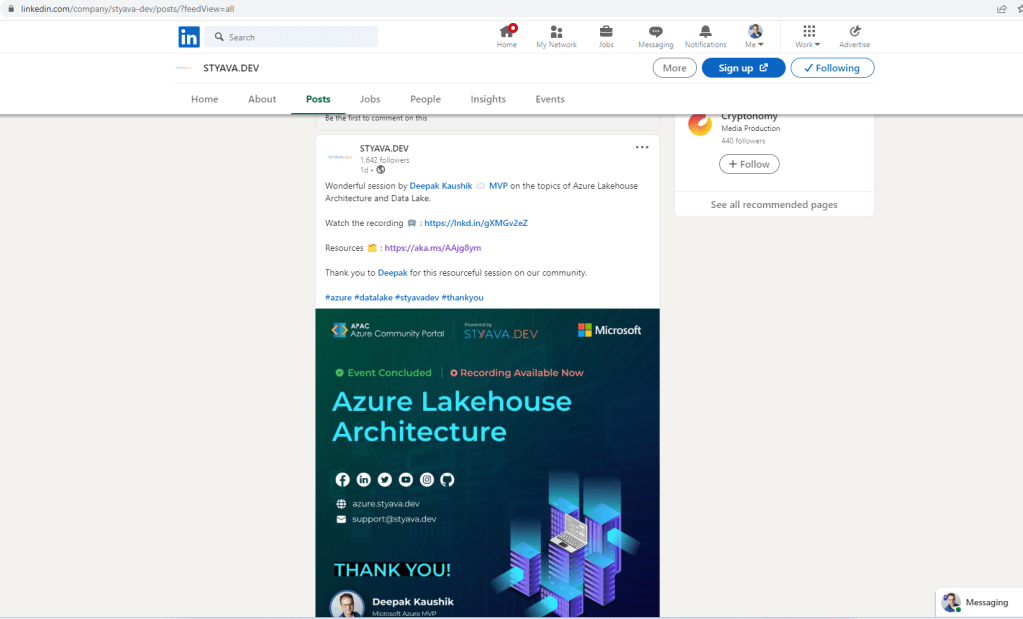
In this video, Deepak Kaushik ☁️ MVP took a thorough analysis of Azure’s powerful world and explored its various architectural components, covering everything from computing and storage to security and networking.
Whether you’re a seasoned cloud architect or a beginner in the field, this series has something for everyone.🌟
So, if you’re looking to unlock the full potential of cloud computing, this video is a must-watch!🎉 Watch it here: https://lnkd.in/daxCMw3d
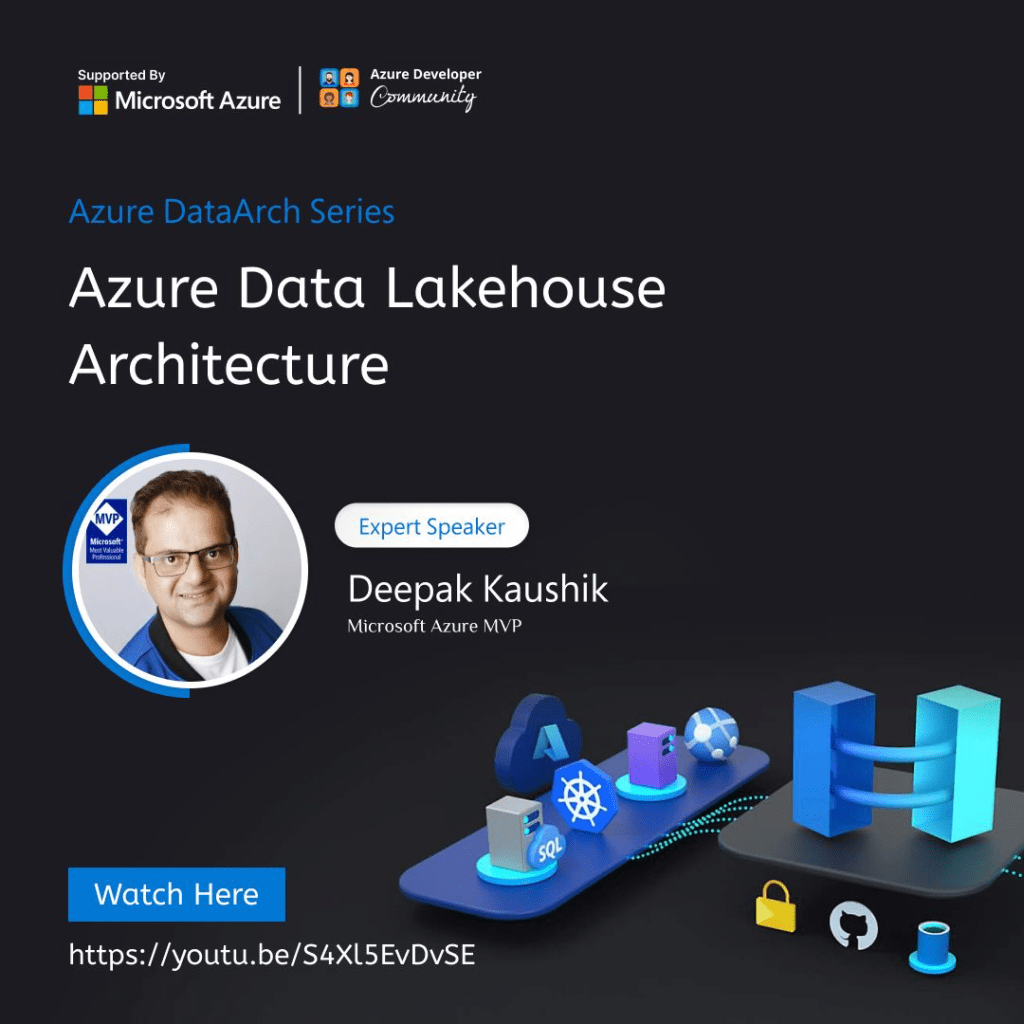
Are you ready to take your data management skills to the next level? Join me for an exciting and informative episode of #azure #Data #architecture series with Azure Developer Community, where we explore the full potential of the Azure Data Lake Framework.
During the live demo, you’ll gain valuable insights into the capabilities of the Azure Data Lake Framework and how it can help you overcome common data challenges. I will walk you through real-world examples and showcase how the framework can streamline your data management processes. You’ll learn how to leverage the power of Azure to process and analyze massive amounts of data quickly and efficiently.
Whether you’re a seasoned data professional or just starting, this episode is perfect for you. You’ll come away with a greater understanding of the potential of the Azure Data Lake Framework and how to maximize its capabilities to benefit your business.
So why wait? Don’t miss this incredible opportunity to learn from a seasoned expert and take your data management skills to the next level.
I’m really grateful to Styava.dev Community for the opportunities to present in 7 APAC countries to an incredible audience. It’s so great to see approx. 190 folks attended the session. As #Microsoft#MVP it is my passion to share to the community and I love it !!
Excited to present “Lakehouse Architecture and Realtime Enterprises Challenges” session at Windsor Hackforge. I will talk about cloud data platform, streaming data, best practices that can make Enterprise successful.
A lakehouse is the flexibility and cost-efficiency of a data lake with the contextual and high-speed querying capabilities of a data warehouse. This enables enterprises to use the single-repository model of data warehouses for unified storage without sacrificing the analytical flexibility of data lakes, allowing data lakehouses to excel at both analytical and machine learning workloads.
Agenda 👉 Concept 👉 Why do we need it 👉 Demo 👉 Q/A
Date 📅 : 10th Feb 2023 Time ⏲ : 08:00 am: BGD | 09:00 am: VNM, IDN, THA | 10:00 am: PHL, MYS, SGP
Azure is a powerful cloud computing platform that offers a wide range of services to meet various business needs. Two popular services within Azure are Azure App Services and Azure Virtual Machines. Both services provide different solutions for different business needs, and in this article, we will discuss their key features and provide some real-world scenarios where they can be used.
Azure App Services
Azure App Services is a fully managed platform for building and hosting web applications and APIs. It provides an easy-to-use interface for deploying and managing web applications, with features such as automatic scaling, continuous deployment, and built-in monitoring and diagnostics.
Real-World Scenarios:
E-Commerce Website: An online store that sells products to customers requires a highly available and scalable web application to handle a large number of transactions. With Azure App Services, businesses can quickly deploy and scale their e-commerce website, ensuring that it is always available and responsive to customer demands.
API Backend: A mobile application that requires data from a backend API can benefit from Azure App Services. The API can be hosted on the Azure platform, allowing for easy scalability and automatic load balancing to handle a large number of requests.
Content Management System: A content management system (CMS) that powers a company’s website can be hosted on Azure App Services. The platform provides a scalable and highly available solution for businesses to manage and deliver their content to their customers.
Azure Virtual Machines
Azure Virtual Machines provide a scalable and flexible solution for businesses to run their applications and workloads on the cloud. It enables businesses to create and manage virtual machines in the cloud, allowing for flexibility in choosing the operating system, language, and software that they require.
Real-World Scenarios:
Legacy Applications: Many businesses still rely on legacy applications that require specific configurations and environments to operate. Azure Virtual Machines provide a solution for running these legacy applications on the cloud without the need for on-premises infrastructure.
High-Performance Computing: Applications that require high-performance computing, such as scientific simulations, can benefit from Azure Virtual Machines. The platform provides access to powerful virtual machines with high-performance processors and GPUs, allowing for the efficient processing of large data sets.
Disaster Recovery: In the event of a disaster or outage, businesses need to be able to quickly restore their critical applications and data. Azure Virtual Machines can be used to create a disaster recovery solution that ensures business continuity and minimizes downtime.
Conclusion
Azure App Services and Azure Virtual Machines are two popular services within Azure that provide different solutions for different business needs. Azure App Services provide an easy-to-use platform for hosting web applications and APIs, while Azure Virtual Machines provide a flexible solution for running applications and workloads on the cloud. By understanding the features and capabilities of these services, businesses can choose the best solution for their specific needs and benefit from the scalability, flexibility, and cost-effectiveness of the Azure platform.
Difficulty that business is facing with current available solution
The data from the source location is not easily extracted and difficult for the business to report on as the tools are not user-friendly or inefficient to gather data when multiple curves as required for the business. The present data source is not designed to pull large amounts of data for analytical purposes and the business is currently pulling the data from source manually.
Which solution does the business looking for overcoming present difficulties
Looking for a cloud solution that will implement a self-serve model/process for accessing the complete data, that is simple to use, provides flexibility in gathering large amounts of data with best performance.
Proposed Architectures to the business
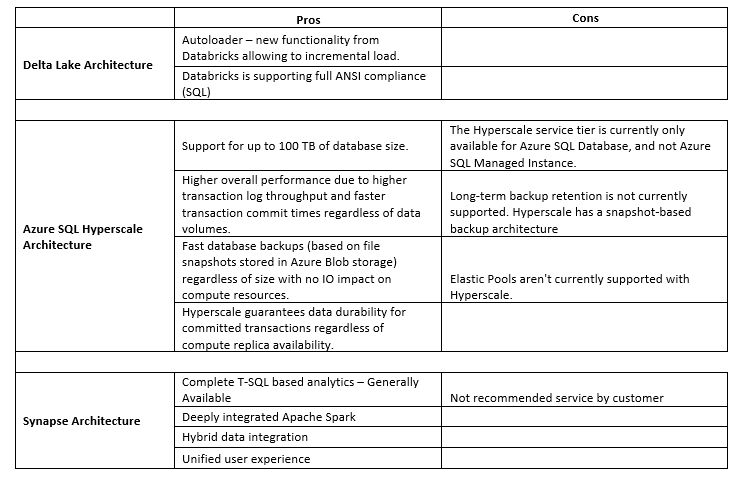
Delta Lake Architecture
SQL Hyperscale
Azure Synapse Analytics
Approved Architecture and proposed solution
Delta Lake Architecture
Delta Lake provides ACID transactions, scalable metadata handling, and unifies streaming and batch data processing. Access/revert to earlier versions of data for audits, rollbacks, or reproduce through Time travel and DML Operations such as SQL, Scala/Java and Python APIs to merge, update and delete datasets can be performed.
Azure Databricks is an Apache Spark-based analytics platform optimized for the Microsoft Azure cloud services platform. Industry leading Spark (Databricks Runtime) built on a highly optimized version of Apache Spark offering 50x performance.
Well Architecture Framework
Cost Optimization
Effective for extremely large datasets
Low latency and reliability
Because of these salient features Delta Lake Architecture is chosen for the business.
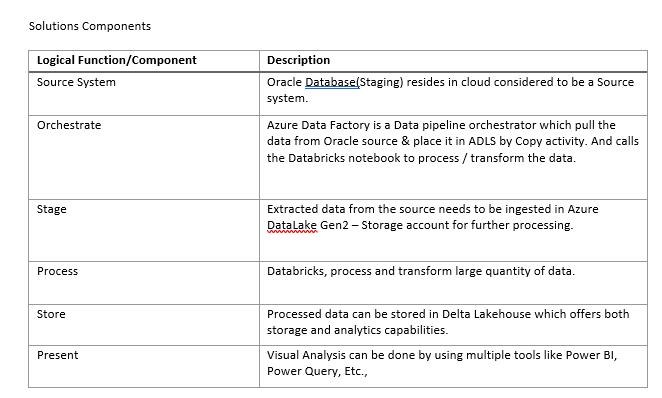
The logical architecture reflects data movement from source systems, transformation through the data platform and load the data in Delta Lake for future reports or Dashboards.
How did we achieved the required solution for the business using approved architecture
Integrating the Oracle System of the business providing the 5 day rolling data to Azure Global container where all the historic and incremental data to be transformed.
This data is transformed using Databricks notebooks by creating staging layers such as Bronze which holds the raw data from Global container then after applying user defined transformation into gold layer. These final delta tables are used for analysis purposes.








 Deepak Kaushik -> Cloud Blooded Beast