Monthly Archives: May 2023

Azure Cognitive Services Overview

*image sourced from Google

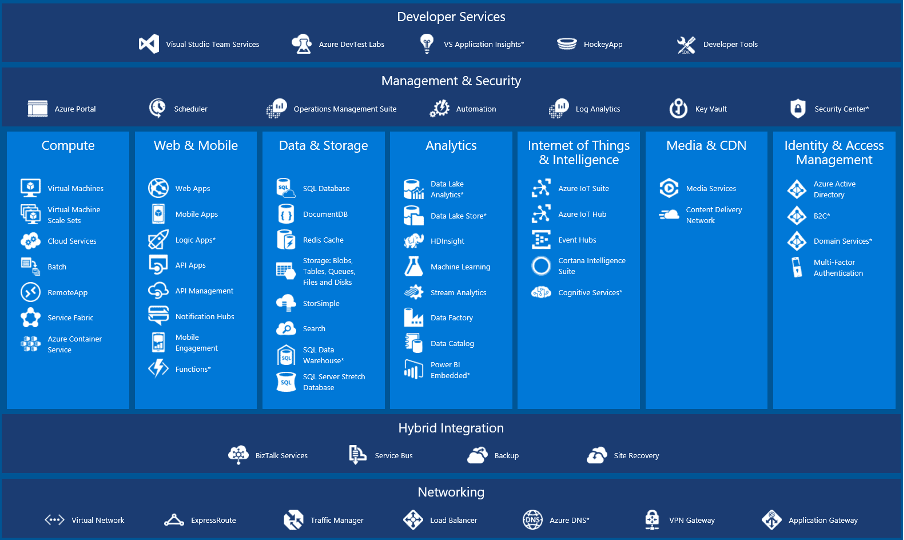
Azure offers a vast array of services tailored to meet the diverse needs of developers. In this article, we’ll explore some of the most popular and powerful services that can significantly enhance your development experience and application capabilities.

Azure App Service: A Fully Managed Platform for Web Applications and APIs

Azure App Service is a fully managed platform that allows you to quickly build, deploy, and scale web applications and APIs written in various languages, including .NET, Java, Node.js, Python, and more. App Service supports multiple deployment options, such as Git, Docker containers, and continuous deployment from Azure DevOps, providing flexibility and ease of use.

Azure Functions: Embrace Serverless Computing

Azure Functions enables you to run code without provisioning or managing servers. Functions are event-driven, scalable, and charged based on consumption, making them ideal for building microservices, data processing pipelines, and integrating with other Azure services. With Azure Functions, you can focus on writing code and let Azure handle the infrastructure.

Azure Cosmos DB: A Globally Distributed, Multi-Model Database Service

Azure Cosmos DB is a globally distributed, multi-model database service that supports various data models, including key-value, document, graph, and columnar. Cosmos DB offers features like multi-master replication, automatic indexing, and tunable consistency levels, ensuring high availability, scalability, and low latency for your applications.

Azure Kubernetes Service (AKS): Managed Kubernetes for Containerized Applications

Deploy and manage containerized applications at scale with AKS, a fully managed Kubernetes service. AKS simplifies the provisioning, scaling, and management of Kubernetes clusters, enabling rapid deployment and scaling of containerized workloads. With AKS, you can easily orchestrate your containerized applications, ensuring efficient resource utilization and high availability.

Azure Cognitive Services: Infuse Your Applications with Intelligent Capabilities

*image sourced from Google

Azure Cognitive Services offers pre-built AI models and APIs that enable you to infuse your applications with intelligent capabilities. Cognitive Services includes functionalities like computer vision, speech recognition, language understanding, and decision-making, empowering you to create intelligent and engaging user experiences.

Azure IoT Hub: Build and Manage Secure, Scalable IoT Solutions
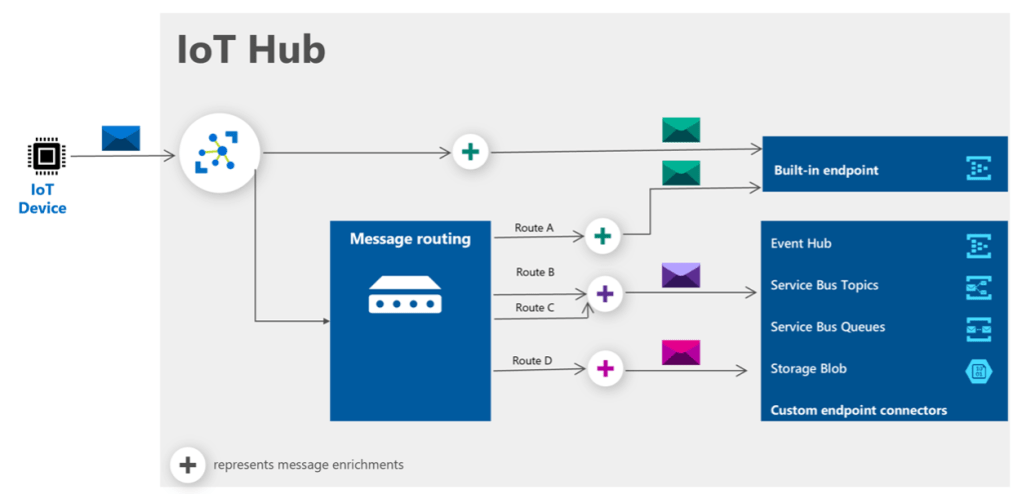
*image sourced from Google

Azure IoT Hub enables you to connect, monitor, and manage billions of IoT devices with ease. Leverage cloud-to-device messaging, device twin management, and seamless integration with other Azure services for comprehensive IoT application development. With Azure IoT Hub, you can create secure, scalable, and reliable IoT solutions.

Azure DevOps: Streamline Your Development Lifecycle

*image sourced from Google

Azure DevOps is a suite of services for version control, agile planning, continuous integration and deployment, automated testing, and monitoring. DevOps enables collaborative development, automated release pipelines, and seamless integration with other Azure services, ensuring a smooth and efficient development lifecycle.

Azure Machine Learning: Build, Train, and Deploy Machine Learning Models at Scale

*image sourced from Google

Azure Machine Learning is a comprehensive service that supports the entire machine learning lifecycle, from data preparation and model training to deployment and management. With Azure Machine Learning, you can build, train, and deploy machine learning models at scale, infusing your applications with intelligent capabilities.

These are just a few examples of the powerful services Azure offers for developers. Throughout the remaining articles in this series, we’ll dive deeper into specific services, exploring their features, use cases, and best practices for leveraging them in your development projects. By familiarizing yourself with these services, you’ll be well-equipped to build, deploy, and manage modern, scalable, and secure applications on Azure.

Introduction to GenAI

Generative AI is a category of artificial intelligence technology that can produce various types of content, including text, imagery, audio, synthetic data and other media using generative models. These systems rely on machine learning algorithms and neural networks, particularly generative models, to create new content based on patterns they’ve learned from vast amounts of existing data.These models are capable of creating content that is not directly copied from existing data but is instead generated based on patterns and information they’ve learned during training.

Generative AI has uses across a wide range of industries, including art, writing, script writing, software development, product design, healthcare, finance, gaming, marketing, and fashion.

*images from google

ChatGPT, example of a text based GenAI chatbot

*images from google

DALL-E, example of a text to image GenAI model

Generative models, a key component of generative AI, are designed to learn the underlying statistical patterns and structures of the training data. By capturing these patterns, they can then generate new data that closely resembles the original dataset. There are several types of generative models, with the most well-known being Generative Adversarial Networks (GANs), Variational Autoencoders (VAEs), and Recurrent Neural Networks (RNNs).

How Does Generative AI Work?

Generative Adversarial Networks (GANs) are a well-known generative AI approach. A generator and a discriminator, two neural networks that cooperate in competition, make up a GAN.

The Generator neural network model’s objective is to produce artificial data that is similar to the real data. It creates content by converting random noise into more organized representations, like pictures. When it comes to text generation, it picks up the ability to put together cohesive sentences and paragraphs.

The Discriminator neural network model’s job is to assess the generated material and identify if it is authentic or fraudulent. It has seen a great deal of actual data and is able to differentiate it from fake data.

The generator aims to create data (e.g., images) that is similar to a given dataset, while the discriminator’s job is to distinguish between real data and data generated by the generator. The generator continually refines its approach to create content, trying to deceive the discriminator into accepting its creations as real. Meanwhile, the discriminator becomes increasingly skilled at telling real from fake. This dynamic creates a feedback loop that pushes both networks to improve their performance over time.

Transformers

The power of generative AI comes from the use of transformers. Transformers produced a 2018 revolution in natural language processing.

Transformers, introduced by Vaswani et al. in the paper “Attention Is All You Need” in 2017, are a type of neural network architecture designed to handle sequential data, making them especially well-suited for Natural Language Processing (NLP) tasks. 

Image Credit: Google Cloud Skill Boost

At a high level, a transformer model consists of an encoder and decoder.The encoder encodes the input sequence and passes it to the decoder, which learns how to decode the representation for a relevant task.

While transformers themselves are not inherently generative models, they provide a crucial foundation for generative AI. In generative AI applications, transformers can be used to generate content, such as text, images, or even code, by leveraging their ability to capture complex patterns and relationships within the data.

Applications

There are numerous uses for generative AI in a variety of sectors. Here are a few noteworthy instances:

Art & ingenuity: Generative AI is capable of producing unique works of poetry, music, and art that frequently test the bounds of human ingenuity. It has made it possible for musicians and artists to experiment with new mediums.

Content Generation: To save time and resources, content creators can utilize generative AI to automate the creation of articles, reports, or product descriptions.

Image and Video Generation: Lifelike images and videos can be produced using generative AI, which has uses in design, entertainment, and advertising.

Generative AI in healthcare: It can help create artificial medical images to help diagnose illnesses or train medical personnel.

Natural language processing: This technology can be applied to the creation of chatbots, conversational agents, and even language translation.

Anomaly Detection: In cybersecurity, generative AI can help detect anomalies in network traffic or identify fraudulent activities.

Code generation: Generative AI can assist developers by real-time code auto-completion and suggestions. Help you debug your lines of source code, explain your code to you line by line, translate code from one language to another, generate documentation and tutorials for source code and much more.

Conclusion

Rapid advancement has allowed generative AI to become a game-changing technology that has the power to completely disrupt several sectors. Its capacity to produce content that is nearly identical to that of human labor creates new avenues for automation and creativity. But it also brings up significant moral and societal issues, like worries about deepfakes and improper use of this technology.

It is critical that developers, researchers, and society as large handle these issues in a responsible and moral manner as generative AI advances. Generative AI has the potential to unleash hitherto unimaginable levels of creativity and invention given the correct methodology.